Friday, July 17, 2020

Twink Williams Burns '06 Is Not Okay: More Black Angst and Undocumented Oppression from Williams College

WILLIAMSTOWN, MA - If you have a white child applying for admission to Williams College this year, you might want to peruse the Facebook comments of one of the school's most visible admission and financial aid staffers

Her name is Twink Williams Burns '06. She is lighting up the local news and social media with her frustration with Williamstown, MA and all things Williams College. For example, she claims a family member was not served at a business in Williamstown. She declined, however, to back up that accusation.

"The person who refused service to my family member no longer works at the local business," she writes, "Please respect that we do not wish to name to local business at this time."

Ms. Burns is a graduate of Williams College, and - according to her LinkedIn profile she majored in English. 

She has had a long-running, off and on, career at the school. For example, she started in her current role as a Strategic Adviser for Admission and Financial Aid in July 2019. However, she was the Associate Director of Admission for Diversity Recruitment between June 2013 and June 2015. As far as I can tell, her first job after her graduation was as an Admission Counselor at Williams between June 2006 and July 2008.

She is married to another admissions staff member, Markus H. Burns 06'. He currently serves as an Associate Director of Admission.

Perhaps to balance out his wife's outspokenness, he has a low profile on social media. Like his wife, however, he has moved in and out of employment at Williams. On LinkedIn, he reports he served as an Assistant Director of Admissions between July 2013 to August 2016. His current run as an Associate Director started in August 2019 after he spent three years as the Assistant Dean of Admissions at Princeton. 

Twink's story, but not her name, was recently addressed over at Ephblog. As far as I can tell, her frustration with her overwhelmingly racist neighbors is making waves. Here is a sample of a recent rant she posted on Facebook:
We’re a Black family, we live in Williamstown, and we are not okay.

We are scared for our physical safety. Yes, here in Williamstown.

We don’t know what to tell our kids without ending their childhoods. Yes, here in Williamstown.

A family member was not served at a business. Yes, here in Williamstown.

We don’t want our pictures taken for the Front Porch Project because we don’t want to be easily located by people who would wish us harm based on the color of our skin. Yes, here in Williamstown.

Someone posted earlier that the N-word is “regularly used by local kids”....how in the world do I tell my sons that someone will call them this word, a word used to enslave and lynch and oppress their family tree, because of something they cannot change? That’s here in Williamstown, and apparently widely dismissed.

Please, instead of asking me what I’ll say to my Black sons to keep them safe, ask yourself what you’re saying to your non-Black children to ensure they aren’t complicit in the oppression of my children, my family, me. Here in Williamstown.

We are a Black family, we live in Williamstown, and we are not okay.

******
Edit: the person who refused service to my family member no longer works at the local business. Please respect that we do not wish to name to local business at this time."
All in all, her posts on Facebook sparked a great deal of consternation. She was particularly vocal at the Williamstown Select Board meeting on June 22, 2020. According to Stephen Dravis, a reporter with iBerkshires.com, she let loose on the group
Burns, who wrote a well-circulated Facebook post about her family's experience with racism, said she did not plan to speak at the meeting and that she was "deeply disappointed" that it took a social media post to bring the issue to the forefront in the town.
"How do I tell my children that this place that calls itself loving and progressive and welcoming is actually going to be a place where they have to get used to the fact that one of their peers is going to call them the 'n word' because their parents aren't bold enough to talk to them about it?" Burns said. "We're doing all of our children a disservice. Not just my children. We're doing your children a disservice when we don't talk about this. And I'm not just talking about in our school, I'm talking about in our town. I'm talking about in our homes. I'm talking about whenever we're out and about.
"If we don't fill that space with important information about the way that we've all been conditioned to see other people in this country that's built on white supremacy, we're basically co-signing that it's OK for our white youth to slip in the 'n word' when it's fun with their friends. Because they've never been challenged to think about it in a more critical way."
Amazingly, the Select Board even considered the idea of decorating the town with Black Lives Matter banners. Theoretically, these banners would replace the ones that routinely hang from the lamp poles in the downtown district, those are the seasonal banners that advertise local museums and such. The obstreperous Twink was opposed to that too.
"I don't understand why we're spending so much time talking about banners versus paint versus whatever," she Burns said. "I love that someone said earlier that we need to have some sort of physical sign that Black people who visit our town should feel welcome here. I would love for that to be true.
"But right now, putting up the sign would be a lie. … I don't think Black people should feel comfortable in our town."
At the very least it looks like the greedy grievance bureaucrats at Williams College have run out of soft targets for their ire.

Due to COVID-19, they no longer enjoy the advantages of working through student proxies and using what ex-professor Eric Knibbs has aptly called a high low strategy. With nothing left to do, they have focused their attention on the gentle, fragile, seemingly easily intimidated, residents of the town.

To me, Twink's histrionic rants are powerful evidence the demand for racism exceeds its supply.

John C. Drew, Ph.D. is an award-winning political scientist and a former Williams College professor. He is an occasional contributor at American Thinker, Breitbart, Front Page, PJMedia and WND.


Tuesday, July 14, 2020

International Man of Mystery: Williams College Observers Ask, Who is Eric Knibbs, and Why Did He Resign?

WILLIAMSTOWN, MA - Secure in a dream job in medieval history at Monumenta Germaniae Historica (MGH), Eric Knibbs is an American ex-pat who is now free at last to speak his mind regarding Williams College. He is unencumbered by the burdens of advancing in a contemporary American academic career and physically distant from the anti-racist zealots who are ripping apart our nation.

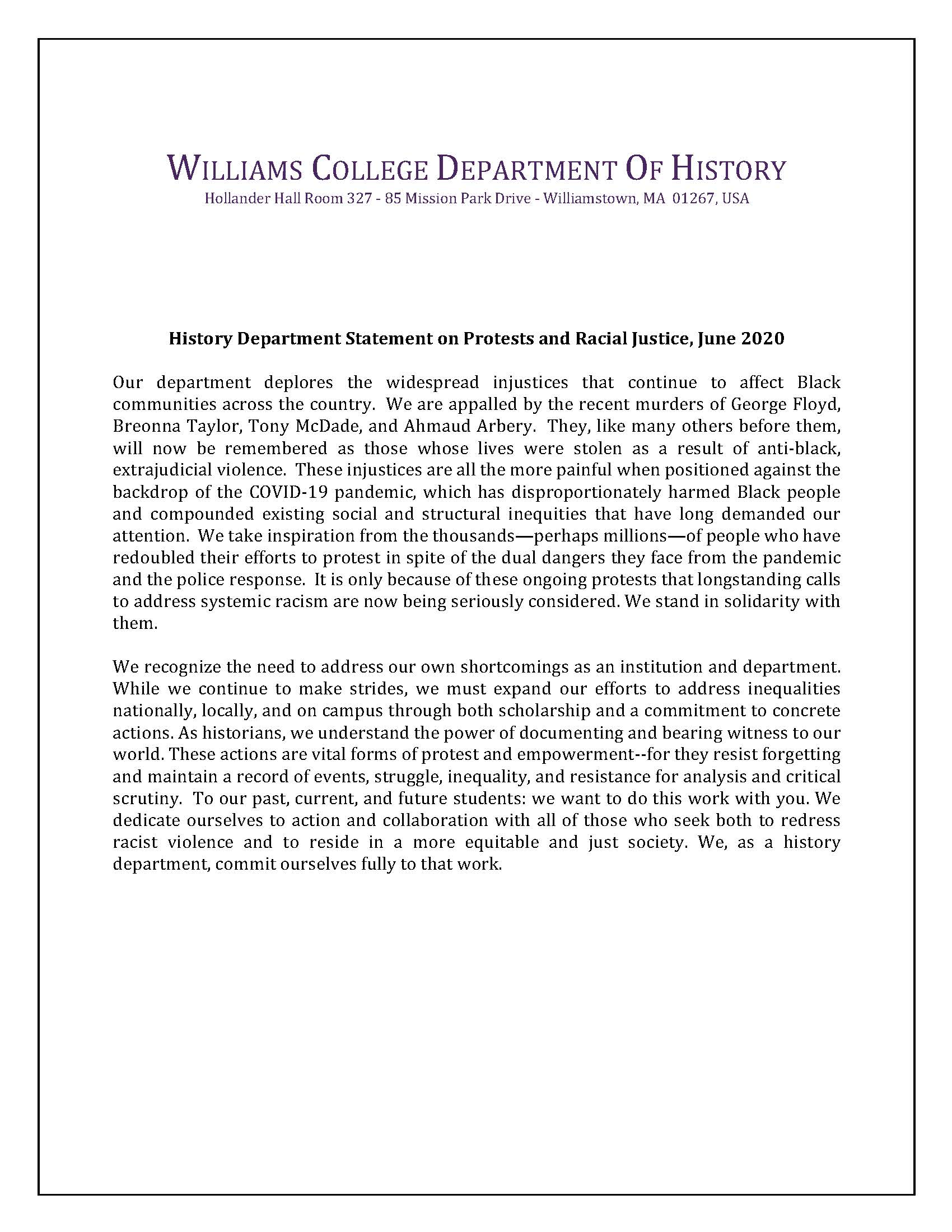
To see what he escaped at Williams College, all you need to do is read up on a recent missive from the history department confessing its support for rioting and violence throughout the nation.

So, who is Eric Knibbs? 

Eric is a scholar of early medieval legal history, and the current editor of the False Decretals of Pseudo-Isidore. He is part of the MGH which is now housed in the prestigious Bavarian State Library in Munich, Germany.

We can learn a little more about him by looking over his old bio at Williams College which tells us, "Eric Knibbs is a historian of the Middle Ages, with a particular interest in early medieval canon law and the phenomenon of medieval forgery. He received his Ph.D. from Yale in 2009, and has done postdoctoral work at the University of Pennsylvania in Philadelphia and the Ludwig-Maximilians-Universität in Munich."

He does look like he was a young phenomenon. He published his first book within two years of getting his Ph.D. prior to starting at Williams College. The bio reports: "He is the author of Ansgar, Rimbert and the Forged Foundations of Hamburg-Bremen (Farnham: Ashgate, 2011), which argues that most of the early documentation for the archdiocese of Hamburg-Bremen, a fixture of German historical scholarship that has long been viewed as fundamental for the history of Christianity in Scandinavia, is either forged or falsified. In fact, the archdiocese emerged much later than scholarship has assumed, and our understanding of Frankish expansion and missionary history during the reign of Louis the Pious (814–840) has been accordingly distorted." 

I suppose you could read him, from a leftist perspective, as a scholar fully devoted to uprooting Christianity by demonstrating the insincerity of some of its proponents going as far back as the Middle Ages.

I assume that Eric wrote the following comments himself describing the nature of his research saying, "His current research focuses on the extensive and notoriously difficult legal forgeries associated with Pseudo-Isidore. Concocted in the ninth century, the fake laws of Pseudo-Isidore remained undetected until the early modern period and exercised an incalculable influence on the legal tradition of Roman Christianity. By studying the sources of the forgeries, their early manuscript tradition and the broader political and religious context in which they emerged, he hopes to shed new light on the identity of the forgers, the context of their work, and their enormous significance for early medieval history."
Selected Publications

Books:

Amalar: Liber Officialis/On the Liturgy, English translation, facing-page Latin edition, with notes, introduction and index. Dumbarton Oaks Medieval Library 35 and 36 (Harvard University Press, 2014), 2 vols, 1231pp.

Alcuini Eboracensis: De fide sanctae Trinitatis et de incarnatione Christi libri tres. Latin edition with introduction and critical apparatus; together with Prof. E. Ann Matter of the University of Pennsylvania. (Turnhout: Brepols, 2012). 250 pp.

Ansgar, Rimbert and the Forged Foundations of Hamburg-Bremen (Farnham: Ashgate, 2011). 270 pp.

El cartulario del monasterio aragonés de San Andrés de Fanlo: Siglos X-XIII. Latin edition with introduction and notes; together with Prof. Carlos Laliena Corbera of the University of Zaragoza (Zaragoza: Universidad de Zaragoza, 2007). 255 pp.
Articles:

“Pseudo-Isidore in the A1 Recension,” in Karl Ubl and Daniel Ziemann, eds. Fälschung als Mittel der Politik? Pseudoisidor im Licht der neuen Forschung (Hannover, 2015), 81–95.

“The Interpolated Hispana and the Origins of Pseudo-Isidore,” Zeitschrift der Savigny-Stiftung für Rechtsgeschichte: Kanonistische Abteilung 99 (2013), 1–71.

“Pseudo-Isidore at the Field of Lies: Divinis praeceptis (JE †2579) as an Authentic Decretal,” Bulletin of Medieval Canon Law n.s. 29 (2011/2012), 1–34.

“The Manuscript Evidence for the De octo quaestionibus Ascribed to Bede,” Traditio 63 (2008), 129–83.

Why did he resign after getting tenure at Williams College? 

At this point, I am trying to balance my desire to help Eric get his story on the record with my desire to have a life. I am tempted to read through every blog post and truly understand his noteworthy scholarship and its relevance. It is too deep in the weeds for me. Nevertheless, I think it should be clear to any objective reader that he is the real deal - a scholar of exceptional productivity. He is the sort of academic specialist who I imagine might be offended and bothered by attempts to sabotage his efforts by asserting they are not sufficiently woke. 

As a young professor at Williams College in the last 1980s, I remember having an epiphany that the school was the sort of place designed to allow an obsessed academic to focus on their scholarly pursuits in perfectly comfortable and serene conditions. The pay was not much, but you could blissfully lose yourself there. You could concentrate, and never bother to look up from what obsessed you. This, in the end, that wasn't enough for me. It looks like the failure of the school to provide that comfortable cocoon for Eric meant it wasn't enough for him either. 

Wednesday, July 8, 2020

In Awe of Eric Knibbs - America's Most Courageous Professor

WILLIAMSTOWN, MA - It is difficult to describe how refreshing it is for me to read some of the recent
writing by a tenured ex-Williams College history professor, Eric Knibbs. The guy is amazing. He tears apart the leftist demons running the school while simultaneously dragging in 5th century Christianity, Plato, and the destruction of previously inoffensive statues.

His latest missive is an insightful response to a complaint over on Ephlog that it is a sign of considerable ignorance to ask for evidence from a black professor who thinks a leftist bastion of Marxist ideology is engaging in violence and murder simply because it does not spin on a dime and give black, gay, transgender professors everything they want now. Like Kayleigh McEnany beating the crap out of leftist writers at a White House press conference, Knibbs responds with devastating accuracy. It is worth reading his response twice.

For me, his best work is the observation that leftist ideology leads to the most predictable loss of freedom:
The more coherent expressions of wokery are nothing but a kind of low-resolution applied Foucaultianism. Its proponents believe some variation upon the proposition that cultural discourses structure power relationships. These discourses must therefore be changed or subverted or inverted in order to achieve more just outcomes.
At the crassest, quotidian level, certain words are therefore tabooed, microaggressions defined, etc. (A lot of this is termed “political correctness” by outsiders to the religion, for whom this is mostly puzzling pedantry.)
At more revolutionary levels, the woke attack racist power discourses by destroying statues and public monuments. This is why the woke opposed some faculty signing a petition about the Chicago principles. A college-wide commitment to free expression threatens their pseudointellectual discourse-engineering agenda.
That last sentence is expresses the observation I admire the most: "A college-wide commitment to free expression threatens their pseudointellectual discourse-engineering agenda." 

This puts the fight at Williams over the Chicago Principles into a clear statement that explains what was really at stake for the CARE-Now students who believed humiliating young white liberal students on the College Council was an admirable course of action. It reminds me of why I was exposed to unrelenting hostility when, as a young political science professor, I publicly supported George W. H. Bush and became a Republican candidate for the local assembly seat. At the time, I was startled at how quickly I had gone from being a Marxist acquaintance of the young Barack Obama to my new status as an out and out racist. I was, of course, easy to remove. Embarrassingly, I was perhaps even easier to gaslight. 

Luckily, ex-Williams College professors like Eric Knibbs can now leverage the power of Twitter, and their personal blog sites, to get out the news of how they have been intimidated and mistreated. His story shows how risky it is to be even a well-meaning cynic regarding the left. To his credit, his recent article strikes me as the boldest and most courageous statement I have seen from a Williams College professor, ex or otherwise. As far as I can tell, only political science professor Darel Paul has even come close. 

At any rate, I am pleased to do what I can through my own blog and Twitter accounts, friendships, and connections to assorted conservative websites, to get the truth out to the public. There are angry mobs dominating schools like Williams. 

As Knibbs observes, there are no sensible solutions for "...indefensible demands that the college needs to double down on wokery, triple down on wokery. And, should it do that, the complaint would then be that it has not quadrupled down on wokery, or quintupled down on it, and so forth."

Please enjoy reading his comment in full below the break. You might also wish to follow the debate over at Ephblog by clicking on these links in order. 


John C. Drew, Ph.D. is an award-winning political scientist and a former Williams College professor. He is an occasional contributor at American Thinker, Breitbart, Front Page, PJMedia and WND.